
Samajwadi Party chief Akhilesh Yadav likened Uttar Pradesh Chief Minister Yogi Adityanath to an infiltrator, saying he is from Uttarakhand and should be sent back to the state. Yadav also criticized the BJP's governance and alleged injustices against Dalits and backward communities.

From the Sensex pack, HCL Tech, Infosys, Tech Mahindra, Reliance Industries, Bajaj Finserv, ICICI Bank, Tata Motors and Eternal were the lead gainers. Power Grid, Adani Ports, IndusInd Bank, Nestle, HDFC Bank and Hindustan Unilever were among the laggards.

'An asset must generate income. Equities yield dividends, bonds pay coupons, deposits give interest, and real estate earns rent.' 'Gold, silver, and even Bitcoin produce no income, they merely store value. So, they should not be compared to productive assets.'

Who else will take on the might of Microsoft, Google, and Amazon if not the Adanis, Ambanis, Birlas, or Tatas?, asks R Jagannathan.

The steep 50 per cent tariffs imposed by the United States on Indian goods are largely a result of President Donald Trump's 'personal pique' at not being allowed to mediate in the India-Pakistan conflict, according to a recent report by American multinational investment bank and financial services company Jefferies.

'The outlook for the next Samvat is more constructive, as many of the earlier drags are gradually becoming supports.'
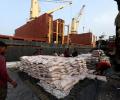
Apex exporters body FIEO on Tuesday expressed serious concerns over high US tariffs on Indian goods and said that textiles and apparel manufacturers in Tirupur, Noida, and Surat have halted production amid worsening cost competitiveness due to these steep duties. The US duties on Indian goods will increase to 50 per cent from August 27.

Billionaire Mukesh Ambani's Reliance Industries has retained its position as the highest-ranked Indian company on the 2025 Fortune Global 500 list, according to the latest rankings released by the publication. The oil-to-telecom-and-retail conglomerate has been ranked at No.88 on the latest list, down from 86th position in 2024.

Indian investors are paying hefty premiums to invest in China markets, with stocks there posting their biggest weekly gain in nearly 16 years. Savvy investors were seen making a dash to invest in the only two China-focused exchange-traded funds (ETFs) available in the domestic markets. On Friday, Mirae Asset Hang Seng Tech ETF closed at Rs 16.9 on the NSE, nearly

Finance Minister Nirmala Sitharaman on Tuesday asked fintech firms to focus on risk management at a time when criminals are using AI to mimic voices, clone identities and create lifelike videos to manipulate people.

'We don't make films for profit and that's exactly why profit follows.'

'Returning Indians can leverage their international skills and the strong funding environment for start-ups here.'

While a giant, it's a nimble-footed one, and is growing at a speed that even some of its private sector peers find enviable.
Between FY18 and FY24, it doubled its balance sheet. Despite being a late entrant in some segments, it has been able to grab market share, observes Tamal Bandyopadhyay.
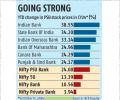
Stock Market News today, PSU banks: The year 2024 was a roller-coaster ride for Indian stock markets, marked by volatility driven by the Lok Sabha elections, Union Budget 2024, a slowdown in corporate earnings, and sticky inflation. Geopolitical tensions - particularly between Israel and Iran in West Asia - along with various stimulus announcements by China and yen carry trade rocked the equity markets throughout the year.

'India is a big market for StanC, and it is also fastest growing economy in the world.'

'We continue to view India as a standout within EM.'

'With continued focus on votes, upcoming by-polls and purchasing politicians, the political hierarchy has little time for national defence.' 'They would do well to heed a veteran scholar, who says, "There will be war with China in the next few years. The next full scale war will have the involvement of Pakistan and terror elements, insurgents and intelligence assets operating inside India",' warns Lieutenant General Prakash Katoch (retd).

The Indian equity markets will soon account for over a fifth of a key emerging market (EM) benchmark tracked by funds with assets exceeding $500 billion. This development is expected to funnel as much as $3 billion into the domestic markets. Following the latest review undertaken by global index provider MSCI, India's weighting in the MSCI EM index will surpass 20 per cent for the first time, narrowing its gap with the current top-weighted China to fewer than 400 basis points.

The MiG-21 episode demonstrates that procurement is always strategic.
Choices about what aircraft to acquire, who builds them, who supplies the spares, who trains the pilots and technicians are decisions with political consequences lasting for decades.
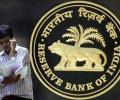
The Reserve Bank of India (RBI) was a net seller of the US dollar in August, reversing its net buying position from July. During the current financial year up to August, the central bank had sold a net $1.11 billion. The RBI sold a net total of $6.49 billion worth of the foreign currency in August, according to the central bank's monthly bulletin.

From the Sensex firms, Eternal climbed 3.32 per cent. Bharti Airtel, IndusInd Bank, Tech Mahindra, Reliance Industries, Tata Motors, HDFC Bank, Tata Steel and Hindustan Unilever were the other major gainers. However, Bajaj Finserv, Axis Bank, Tata Consultancy Services, Titan and Larsen & Toubro were among the laggards.

Why can't the Indian government propose to the Chinese a corridor circumambulating the Holy Mountain where people from both sides could perform the yatra again? asks Claude Arpi.

Analysts believe Tesla will first focus on building the Model Y brand before expanding -- both in terms of volume and models.
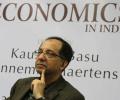
Former World Bank Chief Economist Kaushik Basu on Thursday said the US economic policy towards India has taken an unfortunate turn, noting that President Donald Trump's harsh stance against New Delhi appears baffling. US President Donald Trump on Wednesday announced a 25 per cent tariff on Indian goods from August 1, amid signs of a stalemate in the ongoing bilateral trade negotiations between the two countries.

Zhao Xintong received a 20-month ban in January 2023 after a match-fixing scandal that rocked the sport, the repercussions of which meant he was classed as an amateur at the World Snooker Championship.

Stock markets will be driven by further developments on the US-China tariff war front along with quarterly earnings announcements from IT majors Wipro and Infosys in a holiday-shortened week, analysts said. Global market trends and trading activity of foreign investors would also dictate market movement this week, experts noted.

'From tariff tensions and border skirmishes to unrest in West Asia.' 'The worst may be behind us. But any further upmove will now have to come from earnings.'

'Market momentum and investor interest are at unprecedented levels, making this the opportune moment.'

From the Sensex firms, Adani Ports, Eternal, Bajaj Finance, Axis Bank, Bajaj Finserv, Reliance Industries, Power Grid and NTPC were the major gainers. Sun Pharma, however, tanked over 5 per cent.

The US' move to raise the tariff on most Indian goods to 50 per cent could drag India's GDP growth for FY26 by 35 to 60 basis points, according to various economists. One basis point (bp) is equal to 0.01 per cent.

Among Sensex firms, Asian Paints, Bajaj Finance, Tata Steel, Bajaj Finserv, ICICI Bank, Maruti, Reliance Industries, HDFC Bank and Mahindra & Mahindra declined. Tech Mahindra, Tata Motors, Infosys, HCL Tech, IndusInd Bank and UltraTech Cement were among the gainers.
The crisis may not be as visible this time, but the stakes are just as high, points out Rajeswari Sengupta.

More than half of all new project announcements in the June 2025 quarter came from the manufacturing sector. Manufacturing projects worth around Rs 2.3 trillion were announced in the three-month period, accounting for 54 per cent of total new projects, according to data from the Centre for Monitoring Indian Economy (CMIE).

The RBI added roughly 3 tonnes in 2025, taking its gold reserves to 879 tonnes as of January 31, 2025.

Indian economy grew by 7.8 per cent in April-June -- the highest in five quarters -- before the disruptive US tariffs were imposed.

'Companies like Tesla and others have been given a long rope in India.'

Businesses are testing new markets, tapping into domestic demand, and pushing the government for relief.

'When you have the best market at your doorstep, international diversification is a distraction.'

'Just the amount of work which is there just to become more and more successful in banking. For this to happen you need to have leaders who understand technology.'

To enable Indian banks and financial institutions to develop an aircraft-leasing ecosystem at GIFT City, the Ministry of Civil Aviation has sought support from the Ministry of Finance. It has also raised concern over slow progress in developing aircraft leasing in India.
